When planning any outdoor electrical project, from adding a backyard receptacle to running power to a shed, the National Electrical Code (NEC) provides the baseline for safety. These rules address the unique risks of outdoor environments—moisture, corrosion, physical damage, and the complexities of underground installation. Compliance is not optional; it is a legal requirement in most jurisdictions and a critical step in preventing electrical hazards.
The NEC distinguishes between “damp” and “wet” locations. A damp location is protected from direct weather, such as under a porch roof, while a wet location is exposed to the elements. This distinction determines the type of receptacle and cover required.
Receptacle Placement and Protection
All outdoor receptacles must have ground-fault circuit-interrupter (GFCI) protection, which can be provided either by the receptacle itself or by a GFCI circuit breaker. The only exceptions are for snow-melting or deicing equipment powered by an inaccessible outlet. GFCI protection is designed to cut power quickly if a ground fault occurs, reducing the risk of shock, especially when a person is in contact with the ground.
Residential homes are required to have at least one outdoor receptacle at the front and one at the rear, both readily accessible from the ground and no more than 6 1/2 feet above grade. Attached decks and balconies with interior access must also have a receptacle within 6 1/2 feet of the walking surface. For pools, a receptacle must be located between 6 and 20 feet from the pool's edge, no higher than 6 1/2 feet above the deck, and GFCI protected. Receptacles for pool or spa pumps must be at least 10 feet from the inside walls if not GFCI protected, or 6 feet if GFCI protected, and must be single outlets serving only the pump.
Lighting and Fixture Requirements
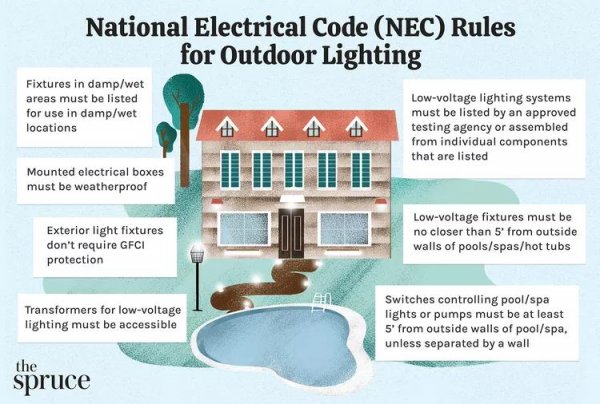
Outdoor lighting fixtures must be listed for their location. Fixtures in wet areas must be rated for wet locations, while those in damp areas must be rated for damp locations. Surface-mounted electrical boxes must be raintight. Unlike receptacles, exterior light fixtures do not require GFCI protection. Low-voltage lighting systems must be listed as a complete system or assembled from listed components, with transformers placed in accessible locations. Low-voltage fixtures must be at least 5 feet from pools, spas, or hot tubs. Switches controlling pool or spa lights or pumps must be at least 5 feet from the water's edge unless separated by a wall.
Cable Burial and Conduit Rules
Standard NM cable is not suitable for outdoor use; instead, cables must be listed for outdoor applications. Type UF cable is the most common nonmetallic cable for residential outdoor runs. Direct-buried UF cable requires at least 24 inches of earth cover. When using rigid metal conduit (RMC) or intermediate metal conduit (IMC), the burial depth is 6 inches; for PVC conduit, it is 18 inches. Low-voltage wiring (30 volts or less) must be buried at least 6 inches deep. Backfill must be smooth granular material without rocks to prevent damage to the cable or conduit. When transitioning from underground to above ground, the cable must be protected in conduit from the required depth or 18 inches (whichever is less) up to the termination point, or at least 8 feet above grade. Overhead service wires must be at least 22 1/2 feet above the water surface of a pool, spa, or hot tub, and data transmission wires must be at least 10 feet above.
Before any digging project, the NEC recommends calling 811, the national “Call Before You Dig” hotline, at least three days in advance. Utility providers will mark underground lines, and power equipment must not be used within 24 inches of marked lines; hand shovels are required within that zone. This practice is not an NEC requirement but is a crucial safety measure.
Following these NEC rules ensures that outdoor electrical installations are safe, durable, and code-compliant. Homeowners should consult a licensed electrician for any project to verify local amendments and ensure proper installation.
Comments 0