When wiring a home, the placement and type of electrical outlets are governed by codes that aim to prevent shocks, fires, and overloading. Most U.S. communities adopt the National Electrical Code (NEC) as a baseline, though local amendments can change specific requirements. Homeowners planning renovations or new installations should consult their local building permit department, as rules can vary from one jurisdiction to another.
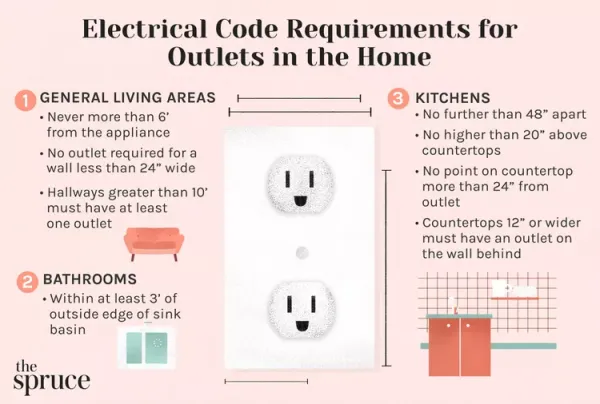
The NEC sets clear parameters for outlet spacing in general living areas. For rooms like living rooms, family rooms, bedrooms, and hallways, the rule under Article 210.52(A)(1) is that no point along the wall floor line can be more than 6 feet from a receptacle. This ensures that lamps, computers, televisions, and other appliances can be plugged in without extension cords stretching too far. Walls shorter than 24 inches are exempt, though an outlet may still be installed if desired. Hallways longer than 10 feet must include at least one outlet, ideally at the midpoint.
In kitchens, the spacing rule is tighter. Countertop outlets must be no more than 48 inches apart, meaning any point on the counter is within 24 inches of a receptacle. This distance is based on the typical cord length of small appliances, reducing the temptation to use unsafe extensions. Any countertop at least 12 inches wide must have an outlet on the wall behind it. Outlets should be installed no higher than 20 inches above the countertop, with exceptions for accessibility needs or kitchen islands where that height is impractical.
Bathrooms have their own specific requirement: a GFCI-protected receptacle must be placed at least 3 feet from the outside edge of the sink basin. While it is common to put the outlet above the counter, the 3-foot rule offers flexibility. Positioning the outlet to the side of the sink, rather than directly behind it, is considered safer. Bathroom outlets should be on a 20-amp circuit and GFCI-protected. A GFCI circuit breaker can protect all outlets downstream, offering a cleaner installation than individual GFCI receptacles, though breakers are not mandatory.
GFCI and AFCI Protection
Ground-fault circuit-interrupter (GFCI) protection is required in areas where water is present or the risk of shock is higher. These include kitchen countertops, dishwashers, bathrooms, laundry rooms, unfinished basements, garages, outdoor locations, swimming pools, and spas. GFCIs detect ground faults and cut power quickly, lowering shock risk. They can be installed as individual receptacles or as circuit breakers that protect the entire circuit. NEC revisions have gradually expanded GFCI requirements over the years, and further expansions are possible.
Arc-fault circuit-interrupter (AFCI) protection has been required since January 1, 2014, for all 15-amp and 20-amp receptacles in general living spaces. AFCIs sense dangerous sparking (arc faults) between wires and shut down the circuit, reducing fire risk. Like GFCIs, AFCI protection can be provided via circuit breakers or individual receptacles. Standard practice is to use AFCI breakers for whole-circuit protection, but individual receptacles are acceptable where breakers are impractical.
Tamper-Resistant and Amperage Considerations
Many municipalities require tamper-resistant (TR) receptacles in general areas. These outlets have a spring-loaded gate that blocks foreign objects, such as knives or paper clips, from being inserted by young children. TR outlets are typically not required for locations 66 inches or higher on the wall, behind large appliances like refrigerators, or when the outlet is part of a light fixture or appliance.
Outlet receptacles must match the circuit's amperage. Most household circuits are 15-amp or 20-amp. A 15-amp receptacle can be installed on a 20-amp circuit, but a 20-amp receptacle must never be placed on a 15-amp circuit, as it could allow a heavy-duty appliance to draw too much power and overload the circuit. Check the breaker in the service panel to confirm the circuit rating before choosing receptacles.
For a 20-amp circuit, the NEC recommends limiting the load to 1,250 watts, which typically allows up to 10 outlets. Outlets should not be installed inside bathtubs or showers, and they must not be placed face-up on countertops. Following the 80% rule—using no more than 80% of a circuit's capacity—is a recommended safety practice. Understanding these codes helps ensure that home electrical systems are both safe and compliant.
Comments 0