Wire Gauge and Ampacity: A Practical Guide for Safe Circuits
Selecting the correct wire gauge for a circuit's amperage is crucial to prevent overheating and fire hazards. This guide explains the American Wire Gauge system, provides ampacity charts for common wire sizes, and compares copper and aluminum wiring to help you make informed electrical decisions.
Choosing the right wire thickness for a circuit's amperage is a fundamental safety step in any electrical project, whether you're installing a new outlet, extending a circuit, or rewiring a room. The gauge—or diameter—of a wire determines how much current it can safely carry. Using a wire that's too thin for the amperage can cause excessive heat buildup, leading to melted insulation or even electrical fires. A wire size chart, which matches gauge to ampacity, is an essential tool for both professionals and DIY enthusiasts.
The American Wire Gauge (AWG) system is the standard for measuring wire thickness in North America. In this system, a higher gauge number indicates a thinner wire, while a lower number signifies a thicker wire capable of carrying more current over longer distances. For example, an 18-gauge wire is relatively thin and suited for low-voltage applications, whereas a 2-gauge wire is thick and used for high-amperage circuits.
Reading Wire Labels and Charts
When purchasing wire, you'll encounter labels that can be confusing. A number followed by AWG (e.g., 14 AWG) indicates the gauge of the entire wire, accounting for any strands within the insulation. If additional numbers appear after the AWG designation, they specify the number of strands and the gauge of each strand. For instance, a label like 10/3 means the cable contains three separate 10-gauge conductors plus a ground wire. For those measuring bare wire with a gauge tool, conversion charts help determine the maximum amperage for both copper and aluminum conductors, along with common insulation types.
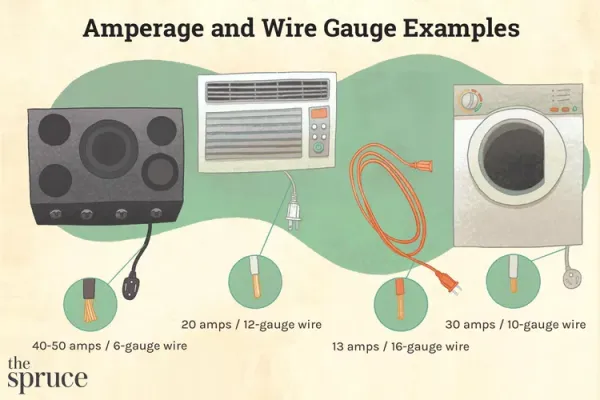
A typical wire amperage chart lists the rated ampacity for various gauges in common applications. For example, 18-gauge wire is rated for 10 amps, suitable for low-voltage lighting and lamp cords. 16-gauge handles 13 amps for light-duty extension cords. 14-gauge is rated for 15 amps, used in lighting circuits. 12-gauge supports 20 amps for kitchen, bathroom, and outdoor outlets, as well as 120-volt air conditioners. 10-gauge is rated for 30 amps, commonly used for electric dryers and water heaters. 6-gauge handles 40-50 amps for cooktops and ranges, while 4-gauge is rated for 60 amps for electric furnaces and large heaters.
Safety Margins and Common Sizes
It's critical to avoid overloading a circuit. Circuit breakers and fuses are designed to trip or blow before wires reach a dangerous temperature, but they are not foolproof. Staying below the amp rating by not plugging too many appliances into a single circuit is a prudent practice. For standard non-metallic (NM) copper cable, common wire sizes and their ampacity include: 16-gauge at 13 amps, 14-gauge at 15 amps, 12-gauge at 20 amps, 10-gauge at 30 amps, 8-gauge at 40 amps, 6-gauge at 55 amps, 4-gauge at 70 amps, 3-gauge at 85 amps, and 2-gauge at 95 amps.
These capacities help you calculate the correct wire size for your project. The smaller the gauge number, the larger the wire diameter, and the more current it can safely carry.
Copper vs. Aluminum Wiring
While copper is the preferred material for modern home wiring due to its strength, durability, and high conductivity, aluminum wire was commonly used in the 1960s and 1970s as a cost-saving measure. However, aluminum has a lower ampacity than copper, requiring a thicker wire to carry the same current. It also expands when heated, which can lead to loose connections and potential fire hazards over time. If your home has aluminum wiring, it's important to consult a qualified electrician before making any changes.

When selecting wire, you also have the choice between stranded and solid conductors. Stranded wire, made of multiple small strands woven together, is more flexible and easier to route in tight spaces, but it can fray and is more susceptible to damage. Solid wire, a single copper conductor, is easier to secure under terminals in switches and receptacles, making it a common choice for rewiring projects that require higher ampacity.

In summary, matching wire gauge to circuit amperage is not just a technical detail—it's a critical safety measure. Always consult a wire gauge chart and, when in doubt, seek professional advice to ensure your electrical work is both safe and code-compliant.

Comments 0