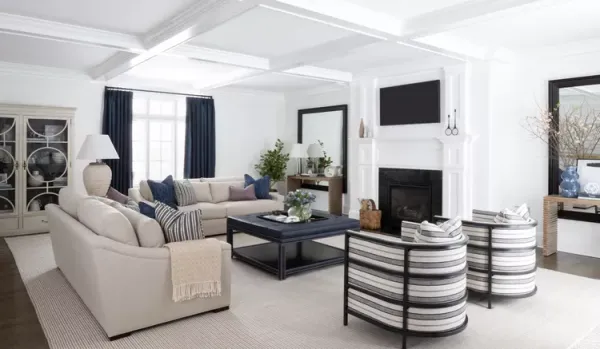
When a room has a tray ceiling, the recessed center panel offers a canvas that interior designers increasingly treat as a focal point. A survey of recent projects reveals two camps: those who use the ceiling to introduce a bold color statement, and those who prefer a quiet, neutral backdrop that lets other elements—like a chandelier or architectural molding—take center stage. Both approaches, when executed with attention to color placement and lighting, can transform the perceived height and character of a space.
Designer Shoshanna Shapiro, whose work appears in several examples, articulates a fundamental rule for tray ceiling painting: paint the vertical surfaces with the wall color and reserve the horizontal surfaces for the ceiling color. This simple division helps define the recessed area without visual confusion. For homeowners planning to hang a statement light fixture, Shapiro advises keeping the box-up feature minimal in texture and detail, so the fixture remains the undisputed focal point.
Color as a Tool for Depth and Drama
Many designers advocate for using the tray ceiling as an opportunity to inject personality. Shapiro notes that clients often worry a painted ceiling will make the room feel lower, but she observes the opposite effect: layering color can make the space feel grander and more alive. When existing wood beams are present, staining them a darker hue can complement the painted ceiling and enhance the overall warmth.
Lacy Hughes of Julian Design echoes this sentiment, suggesting that a darker contrasting color on the tray ceiling makes it pop while still working cohesively with the room's palette. Her firm's projects include a dining room where an earthy ceiling tone pairs with patterned wallpaper, and a bedroom where a deep hue defines the sleeping area. In a bathroom example from Ashley Montgomery Design, a deep sage wall is paired with a white ceiling, creating a serene, spa-like atmosphere.
Light and Neutral Approaches
Not all designers favor bold color. Georgia Zikas, whose work is featured in a living room, explains that the architectural detail of a tray ceiling can be enough on its own. She recommends a neutral white or ivory to let the structure speak for itself, allowing the rest of the room's design to take the lead. Similarly, Sherry Hayslip of Viola Interior Design prefers lighter colors to create a sense of airiness, giving the illusion that the ceiling is floating. She emphasizes that lighting is critical—both up-lighting and down-lighting are needed to ensure the feature doesn't get lost. For a more dramatic effect, she sometimes uses gold leaf or other eye-catching finishes.
On the opposite end of the spectrum, designer Jessica Davis embraces dark paint. She notes that a tray ceiling can create the illusion of greater height and deliver depth and interest. Her go-to shade is Sherwin-Williams' Black Fox, which she applies to the recessed area for a bold, grounded look.
Beyond Paint: Wood, Wallpaper, and Coordination
For those who prefer not to paint at all, wallpaper is a viable alternative. A subtle gray pattern can add texture and style, as shown in a project by Mindy Briar for The Finish. Natural wood is another option, bringing warmth and a welcoming feel to an entryway, as demonstrated in a Britt Design Studio project. Coordination with other room elements is also key: painting the tray ceiling the same color as a fireplace mantel, as seen in a family room, creates cohesion and visual continuity.
Whether the goal is to make a bold statement or to provide a subtle backdrop, the tray ceiling offers a versatile surface. The designers' collective advice underscores the importance of intentional color selection and strategic lighting to maximize the architectural feature's impact.
Comments 0